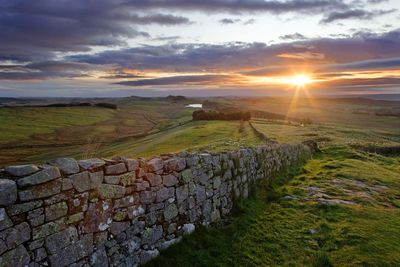
I’m sure everyone knows about the Great Wall of China – but did you know a wall was built by the Roman Empire, in the time of Emperor Hadrian? The wall, known as Hadrian’s Wall was built in AD 122. It took three legions (roughly 15, 000 men) six years to complete. The wall stretches across Britain at its most narrow point – following a natural ridge and extends to the North Sea on the east, and the Irish Sea on the west. A massive engineering feat that is a marvel to behold, traversing rolling hills, crossing rivers, and rough terrain – it measures 80 miles in length. In some areas, the wall was six meters tall, though time has eroded some of its height.
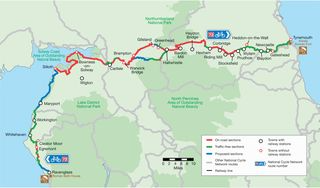
Every Roman mile there was a milecastle, structures which had a gate where people could pass through and where garrisons of men were housed. There were also forts built in convenient places, some still standing today. The wall marked the northern boundary of civilization.In fact, if you would like to see the wall, there are bicycle tours, walking paths, and a myriad ways to see the sights and visit the villages, pubs and shops that mark the wall and its history to the English, Scottish and Roman heritage. The three coexist today – just as in days of old.
Why was the wall built?
There is quite a bit of speculation and legend about why the wall was built. The Roman Empire was one of the greatest accomplishments of all time – militarily. It stretched from the Middle East, the coast of Africa, and across much of Europe, all the way north to Great Britain. How the Romans managed to rule their enormous empire with a relatively small professional army is a spectacular statement of power.
It has been reported that the vast Roman armies, despite the most modern warfare and weaponry, could never really gain a foothold in the northern lands, now known as Scotland. While much of the Roman forces were busy dealing with an uprising along the Danube – what is now Germany – the best of the best were sent to Britain, to expand north. The brave, determined Scottish tribesmen, however, were not to be conquered. They fought fiercely, using guerilla tactics – utilizing the natural phenomenon of mist, and a superior knowledge of the terrain. They fought with chariots which the Romans had long since abandoned, threw fireballs, and disappeared into the mist when the fighting was over.
The disciplined Romans marched abreast in columns, carrying their standards, their swords, and shields. They were no match for the mysterious men who appeared seemingly out of nowhere, surrounding the Romans, using scare tactics and primitive weapons, wearing fearsome clothing and paint, terrifying the ranks of legionnaires who were proud of their bravery and fighting skills. The tribesmen fought fiercely until the Romans were killed or retreating. The Romans won some skirmishes only to see their advantage lost. In time, it was decided that the northern lands were not worth the loss of life and supplies.
The Legend
The most famous army of all of Rome was the Ninth legion. Made up of the finest and best-trained warriors, it was sent to deal with the wild northern tribesmen. The entire army, a contingent of 5,000 men – disappeared. For centuries, the mysterious loss of the Ninth has intrigued scholars, writers, and film-makers. Where did they go? Were they slaughtered? Did they run away and melt into the countryside? Did they join the local peasantry? Were they deserters? The answer (or lack thereof) still teases many historians, storytellers, writers and filmmakers. The Lost Ninth Legion, and the Eagle standard under which they marched remains a vital part of the folklore of Roman, British and Scottish history.
The loss of the Ninth Legion is often purported to be the reason for the building of Hadrian’s Wall. It was a real blemish on the grand and courageous image of the Roman Army. The wall was built to separate the somewhat “civilized” and Romanized citizens of Britain from the barbaric hordes to the north. The wall was guarded for nearly 400 years with no real attack from the north.
The book (and subsequent movie), The Eagle of the Ninth, by Rosemary Sutcliff, attempts to answer the question of the lost Ninth. It may be fictional, but it is well researched. Ms. Sutcliff learned the Celtic and Saxon legends from her mother, a prolific storyteller. Armed with a knowledge of folklore and a penchant for history, she created historical fictions that bring the old legends to life. It is a challenging story to tell, but with determination and practice – I hope to tell it well!


Leave a Reply