 "How often I found where I should be going only by setting out for somewhere else." R. Buckminster Fuller
When I first became caught up by storytelling, I was deeply inspired and molded by brilliant professional storytellers like Donald Davis, Jackie Torrance, Elizabeth Ellis, Olga Loya, and many others who were working in the late 1990s and early 2000s. One of my mentors, Susan Klein, explained to me that to work at the national level, at the National Storytelling Festival for example, a storyteller had to have a minimum of 15 hours of unduplicated material.
A repertoire of this size meant that the teller would have the depth and flexibility to tell for several days without repeating a story, to respond to the needs and energy of their audiences, and effectively take part in festival sessions featuring multiple tellers. These sessions, called olios at the national festivals, demand that the tellers be able to choose just the right story to open, to follow a previous teller, to shift the mood or extend it, or to bring a session to an emotionally satisfying close.
I prepared myself to take my place on those stages. My interest in myth was part of what brought me to storytelling, so I prepared several hour-long myths and created a program called Myth-Informed at SMCC to tell them. That got me to about eight of my fifteen hours. I developed personal and family stories, crafted my own versions of folktales from around the world, and told all the time in my classes and as often as I could in the community.
I got my repertoire to fifteen hours all the while building the Storytelling Institute with my colleagues. I became the co-producer of a national festival at the Mesa Arts Center which brought in the big-name tellers from around the country for several years, and this kept me inspired, motivated, and connected to the scene.
But my dream of regularly joining my heroes and mentors on the stages of festivals around the nation didn’t happen. It took me a long time to realize, and even more to accept, that there is more than one valid way of being a professional storyteller in the world.
I learned that in Ireland, for example, there were traditionally two kinds of storytellers – the seanachie and the scealai. The seanachie specialized in folktales, historical tales, and local history and lore. The scealai specialized in the long heroic, mythic tales that might take several nights to tell. Both types of tellers might exist in a specific community. In addition, there were itinerant tellers who would come through a community bringing news, stories from other places, and fresh takes on familiar stories.
In America today we have both itinerant storytellers and storytellers who are more rooted to a place. The scholar of storytelling and folklore, Jack Zipes, has warned that in America particularly this has led to a “star system” where the itinerant storyteller working nationally can become influenced by market forces that disrupt the core responsibility of a storyteller to serve a community.
This isn’t true for the national level storytellers I’ve been most influenced by, and who I wanted to emulate. Tellers like Donald Davis, Olga Loya, Jim May, Elizabeth Ellis, and Lyn Ford (to name a few) are deeply connected to their families, histories, and communities. I would argue it is a big part of their effectiveness with the diverse audiences they serve around the country.
But the fact is, there are many more storytellers in America now, and many more people who are interested in storytelling, than can make a living at the national level. Most storytellers today find ways to serve either a physical community – a place – or a community of interest. At the Storytelling Institute we meet people who want to tell stories in the community at performance venues, who want to tell stories in their families, and who want to learn how storytelling can make them better at their jobs. And, of course, these things aren’t mutually exclusive. In all cases it comes down to developing a repertoire and learning how to use it to meet a variety of needs.
I have no regrets about the investment of time and energy I made in my repertoire. By doing that, I learned how to be a storyteller. I learned what stories were right for me. I scored story pathways in my brain that exist to this day, and that allow me to access old stories readily and learn new ones efficiently.
It turns out that, like Buckminster Fuller, as I prepared myself to become a platform storyteller, I was becoming a community storyteller and a storytelling educator, who can tell on stage when needed. And at the same time, my colleagues and I were building a storytelling program to help people become whatever kind of storytellers they need to be to best serve their families and communities.
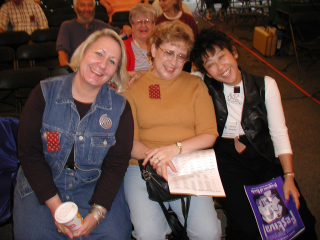
The photo at the top of the post shows Lorraine Calbow, LynnAnn Wojciechowicz, and me (right to left) at the National Storytelling Festival in Jonesborough, TN, in October 2000. Lorraine was the founding director of the Storytelling Institute, followed by LynnAnn. I’ve been the director since 2010.


Leave a Reply