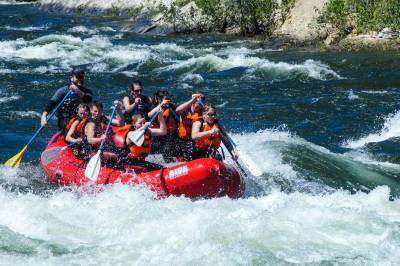
 Pinned on Karma Rock: Whitewater Kayaking as Religious Experience, by A. Whitney Sanford, is a detailed look at a “lived religion;” evaluating whitewater kayaking as a spiritual, sacred encounter. The physical act of kayaking, combined with the intellectual action required for the sport is a method of seeking the divine – in the natural world. There are some wonderful references to Hinduism and Buddhism, used as examples and references for the concept of religious experience.
At first, I found this be a stretch of credibility, but as I got more involved in the article, I realized I could relate to the concept of immersion (in this case, obviously, water) in a physical experience, and finding a sacred, or divine connection to something greater than myself. As a lonely little girl, I often immersed myself in nature, in seeking to understand through the senses by walking, riding my bike for hours, climbing trees, “hanging out with animals,” until I felt balanced and whole (for lack of a better word). Watching a sunrise or sunset, listening to water running through a stream, the wind in the trees, always made me feel a part of something – albeit, I was a very small entity, but it was comforting and allowed me a sense of connection. A connection to something larger than life; profound. These “spiritual” experiences always worked to help me get out of my own head and become immersed in a greater sense of purpose, in a universe that was so much more than my own little life.
I am still that child in many ways – though I see myself as having a voice, as well as a responsibility in the world today. I seek the physical, or intimacy with nature in the same way – to find that sense of connection/spirituality/
As I read further, I could feel, viscerally, the intense use of muscles and the absolute concentration to simply survive the risks of negotiating rapids. In my own practice, I could liken it to taking a grueling dance class where even though one may be surrounded by other dancers, the reality of it was very personal – my body, the music, the floor, the sound of feet, perspiration, breathing: it became a sort of sacred act. A communion of physical and art; an action that required commitment and risk. The intensity of experience manifested in leaving behind one’s comfort zone to pursue an intellectual and physical world that was unpredictable, sometimes frightening, but exhilarating. A “lived religion.” The same could be said of performing on stage where the “real” world dissolves and one becomes completely immersed in the sensation of “otherworldliness.” Mindfulness – being in the moment – losing oneself in the performance.
The concept of ritual that marks something as sacred is not only true for kayakers – but I have seen it myself, in athletes, and dancers. If a ritual is performed often enough, it transforms into the sacred through emotional investment. I think storytelling is sacred in the same way as it often encompasses ritual – in a setting, a repeated pattern of words, and an emotional connection to the words, the audience, and most importantly, the story.
My favorite line: “ . . . what one believes is sacred is sacred.”

Leave a Reply