 His two guardian angels then came to Patrick and he asked them if it were the will of the King of Heaven and Earth that he be listening to the tales of the Fian. They answered him with one voice: ‘Dear holy cleric,’ they said, ‘these old warriors tell you no more than a third of their stories, because their memories are faulty. Have these stories written down on poets’ tablets in refined language, so that the hearing of them will provide entertainment for the lords and commons of later times.’*
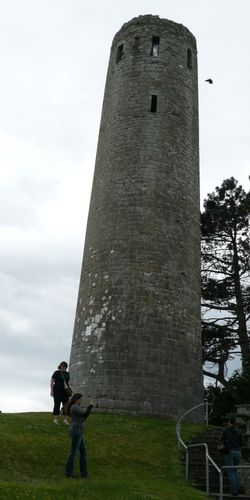
We have texts like the one above from Tales of the Elders of Ireland because of monasteries like Clonmacnoise, a monastic site established in 545 A.D. Although that particular story wasn’t written there, Clonmacnoise held a central role in the bardic system that recorded many of the old stories. We wouldn’t have many of the great tales of Irish myth if the monks at monasteries like Clonmacnoise hadn’t written them down. Robin Flower in The Irish Tradition writes, “No evidence has ever been produced to prove the existence of writing for literary purposes in Ireland before the coming of Christianity” (p. 73).
As I’ve learned more about Ireland in early Christian times, I’ve developed a better understanding of why the Irish embraced Christianity in the fifth and sixth centuries. The Fianna were the warrior bands that patrolled Ireland. There job was to protect the borders and the people. At their best they did that with honor and glory. At their worst they were bloodthirsty gangs. Their exploits make great stories, but the reality of living with them took a toll on the populace. The translators of Tales of the Elders of Ireland write:
(T)he Church moved rapidly into a central and dominant role in Irish society. Once established, it also felt obliged in Ireland, as elsewhere in medieval Europe, to mediate and mitigate the effects of endemic violence in society. Thus it is likely that the Church was the major agent in the demise of the fian as a viable social institution.**
Finn McCool, the greatest leader of the Fianna, represents the best of the honorable warrior tradition. Finn was a poet and a warrior, and known for his generosity. In Tales of the Elders of Ireland, St. Patrick asks Caoilte, the ancient warrior who had served Finn, if Finn McCool had been a good leader. Caoilte responds:
‘Were the dark leaves gold, that the trees discard,
And the white waves sliver, Finn would give away all.’
‘What has kept you warriors alive for all these years?’ asked Patrick. Cailte replied, ‘The truth of our hearts, the strength of our arms, and the constancy of our tongues.’ ***
That last line is what I’d like to see on my tombstone: Elizabeth Ann Warren, 1954-2054, Kept alive for one hundred years by the truth of her heart, the strength of her arms, and the constancy of her tongue.
*Dooley and Roe, Tales of the Elders of Ireland, p. 12, ** p. xii, *** p. 6.
Leave a Reply