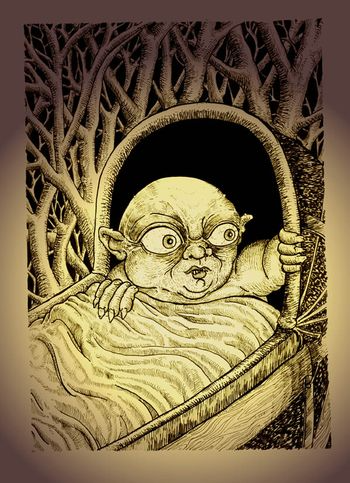
 Remember when you were a teenager, and your parent’s prime duty was to embarrass you? They were good at that. You would put your hands in front of your face and say “I don’t know you”!
Well, perhaps those words should have been spoken by your parents. For maybe you are a changeling, and they don’t know you. The idea of a changeling is common in European folklore, including the country of Germany. A changeling often is the baby of the fairies, switched out for a human infant.
The birth of a baby was not always met with celebration in the fairy world. Their babies were difficult, demanding, a challenge to raise. Not at all like those sweet faced, dimpled, and smiling infants of humans. Fairy mothers were envious, and they wished they could also have such a good baby. So if the parents of that human baby were not diligent and watchful, the fairies would sneak up and take that infant, leaving their own in its place. A changeling.
This child was unlike the others in the family, emotionally and physically. Folklore researchers think perhaps the idea of the changeling evolved from the pattern of succession in a monarchy. Inheritance, especially by the oldest son of the king was a way to gain political and economic power. If there was a doubt as to the legitimacy of that heir, challenges, including warfare, could arise. Was that prince the true son of the king, or could he be a changeling?
The realities of some of these stories reflect a child that was born with physical deformities, disease, or mental retardation. Recent studies of European folktales suggest that autism perhaps resulted in a child being labeled as a changeling. The description in some stories accurately describes an autistic child. This is an interesting subject I am sure we will hear more about in the coming years.
My family is not German, but many of our neighbors were, and the folktales about changelings were common when I grew up. Me? Yes, my mother told me I was a changeling. I was born at the beginning of the gardening season in the north, and disappeared one day soon after. She quickly found me under a cabbage leaf much to her relief. But when I began to talk, I spoke a language no one could understand. No one, except for the German lady who lived just up the road. And that was all the proof my mother needed.
So next time when you tell your parents “I don’t know you”, you might just be right.


Leave a Reply